For South African stores, a bedside pedestal has two jobs. It must look attractive enough on the retail floor to sell, and it must survive storage, handling and long-distance delivery after the customer buys it.
This means South Africa furniture wholesale buyers should not separate display appeal from packaging. A product that photographs well but arrives with damaged corners will not support a stable retail programme.
Display appeal starts with proportion
The pedestal should sit at a sensible height beside the bed, with enough drawer volume to feel useful. Warm lighting, clean handles and a neat top surface can help the showroom display, but the product should still feel sturdy when opened and moved.
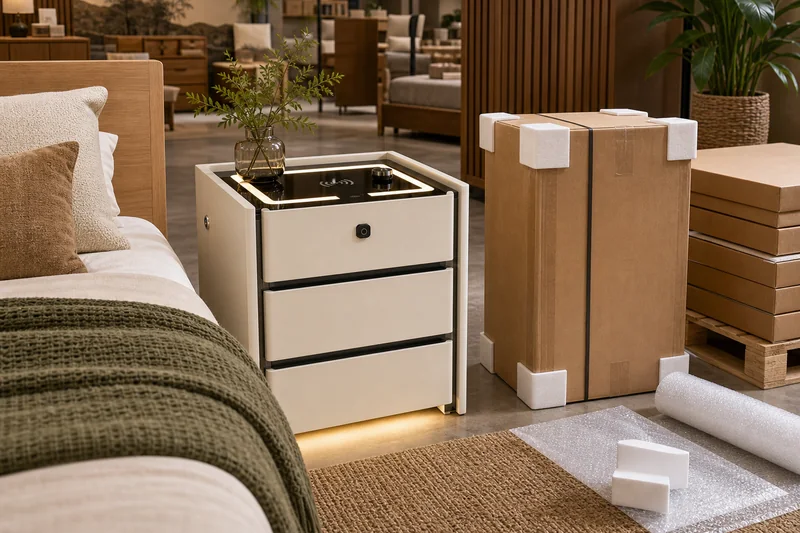
Delivery protection to confirm
- Corner protection for drawer fronts and top panels
- Carton strength for regional transport routes
- Internal spacing that prevents the cabinet from shifting inside the box
- Protection for feet, handles and LED or charging modules
- Clear carton orientation and handling marks without relying on fragile labels only
Retailers serving hotels, lodges or furnished rooms can also connect the product with hotel and lodge bedside pedestal supply. Those projects often require repeated handling before final installation.
The store display should show the product honestly. If the selling point is storage, open a drawer. If the selling point is lighting, show the light. If the selling point is durable finish, keep surface samples or cleaning notes near the sales team.
Packaging should be tested like a feature
A packed sample tells the buyer more than a loose sample. Check the box after movement, inspect the corners, open the drawers, and see whether small parts remain in place. This avoids relying on packaging claims that were never tested.
If the range is planned as a retail brand, spare-parts and display notes should connect with private label bedroom furniture in South Africa. A branded line needs consistent packaging, support parts and sales materials.
A strong bedside pedestal for South African stores is therefore not just a good-looking SKU. It is a product that can be displayed, sold, delivered and supported across distance without losing its value.
Connect the showroom sample to the delivery journey
For a South African furniture store, a bedside pedestal must look convincing on the floor and still arrive in saleable condition after a longer delivery journey. The display sample should show the furniture role first: usable top space, drawer access, stable feet, finish quality and proportion beside a bed. Smart lighting or charging can be demonstrated where relevant, but it should not hide the practical questions a customer will ask. A store team needs to know which model suits a compact bedroom, which provides daily storage and which offers a higher-value feature level without making the range difficult to explain.
The same approved sample should lead to a packed-sample review. Open the carton intended for production and check where corners, drawer fronts, top surfaces and loose fittings are protected. A cabinet that photographs well can still create a poor customer experience if a front moves in transit, hardware rubs against a finish or the store cannot identify a damaged component. Long-distance delivery protection should be matched to the structure of the product, not treated as a generic promise of strong packaging.
Use store feedback to refine the next shipment
After the first display and delivery cycle, separate the evidence. Record which finishes attract attention, whether staff can explain the smart feature, which questions repeat, and whether any damage is linked to a specific corner, drawer or carton position. This allows the buyer to decide whether a change belongs in the display card, the packaging layout, the product specification or the service-parts plan. A useful retail programme does not add a new model for every comment; it improves the proven platform where the sales or delivery data shows a real need.
- Display the cabinet beside a realistic bed, lamp and customer walking path
- Keep finish, dimensions, functions and carton information together on the product record
- Open a production-style carton to inspect front, corner, top and hardware protection
- Classify delivery issues by component rather than reporting all as general damage
- Use sell-through and delivery feedback before adding a new model or finish
When showroom presentation and delivery protection are approved as one system, the store can sell the same product it receives, rather than treating the sample and the carton as unrelated decisions. That consistency supports retailer confidence, clearer staff training and a more predictable replenishment conversation with the supplier.